Selected Publications
Zanti M, …, Michailidou K. Analysis of more than 400,000 women provides case-control evidence for BRCA1 and BRCA2 variant classification. Nat ...
The research activities of the Biostatistics Department focus on the genetic epidemiology of complex diseases, with a primary emphasis on breast cancer. Our work aims to elucidate the genetic architecture underlying disease susceptibility through the integration of advanced statistical methodology with large-scale genetic and genomic data.
Genetic Architecture of Breast Cancer
The Biostatistics Department investigates the contribution of both common genetic variants, identified through Genome-Wide Association Studies (GWAS), and rare variants, detected via next-generation sequencing. By combining these complementary sources of information, we seek to improve understanding of disease risk, heterogeneity, and underlying biological mechanisms.
A key component of our research is the development and evaluation of Polygenic Risk Scores (PRS) for breast cancer. In particular, we examine how differences in genetic background influence disease risk prediction across populations, with the aim of improving the accuracy, calibration, and clinical utility of genetic risk stratification.
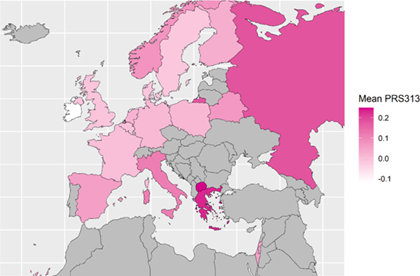 Recently, Mavaddat et al. developed a 313-variant polygenic risk score (PRS313) for breast cancer using data from women of European ancestry participating in the Breast Cancer Association Consortium (BCAC). Building on this framework, we examined the distribution of PRS313 across 17 European countries, as well as among individuals of European ancestry from Australia, Canada, Israel, and the United States. We found that PRS distributions vary substantially even within populations of European ancestry. This variability may lead to underestimation or overestimation of breast cancer risk in specific countries, highlighting the importance of using population-specific PRS distributions to ensure accurate calibration of breast cancer risk estimates across different risk categories (Yiangou et al., 2024.).
Additionally, we were able to assess the predictive performance of the combined effect of PRS15 with classical breast cancer risk factors in Cypriot women from the MASTOS study, demonstrating that PRS15 is significantly associated with an increased breast cancer risk in Cypriot women, OR (95% CI) 1.66 (1.25-2.19) (Yiangou et al., 2021). While also evaluating the predictive performance of the PRS313 in women from the Greek island of Crete, providing evidence that PRS313 could stratify women from Crete according to their individualized overall and ER-specific breast cancer risk, at the extreme quartiles (Yiangou et al., 2022).
Fine Mapping and Disease Etiology
Genome-wide association studies have identified more than 220 regions strongly associated with breast cancer risk. However, post-GWAS approaches are required to refine these associations and identify likely causal variants and target genes. To date, several fine-mapping studies have been conducted, predominantly in populations of European ancestry, collectively refining more than 150 breast cancer susceptibility regions (Fachal et al., 2020).
More recently, fine-mapping efforts have expanded to incorporate multi-ancestry datasets, including non-European populations such as African and Asian cohorts. The largest study to date identified 192 regions comprising 332 independent association signals, prioritised 195 putative target genes, and highlighted key biological pathways, including the PI3K-AKT, TNF-α/NF-κB, and p53 signalling pathways (Jia et al., 2025).
We develop and apply novel statistical methods for the fine mapping of breast cancer susceptibility loci, refining association signals to prioritize likely causal variants. These efforts contribute to a deeper understanding of disease etiology and support the translation of genetic findings into functional and clinical research.
Classification of Rare Variants
Another major research focus of the Biostatistics Department is the classification of rare variants of uncertain clinical significance (VUS) identified in high-risk breast cancer susceptibility genes. We have developed innovative statistical approaches for the analysis of large case-control datasets that account for gene-and age-specific penetrance, enabling more accurate, evidence-based variant interpretation.
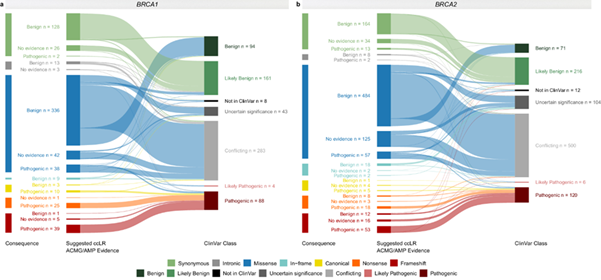
Recently, we have developed a novel case-control likelihood ratio (LR) method that incorporates age information for both variant carriers and non-carriers. This approach enables quantitative evaluation of evidence in favour of, or against, pathogenicity for rare variants in genes with age-specific penetrance estimates derived from case-control studies (Zanti et al., 2023). This methodology was able to provide case-control evidence towards or against pathogenicity to inform clinical classification for 787 previously unclassified variants in BRCA1 and BRCA2, many of which were originally considered of uncertain clinical significance (Zanti et al., 2025).
Our work also extends to ovarian cancer, where we have analyzed large-scale datasets and contributed to the development of evidence-based guidelines for the use of tumor characteristics in the classification of germline VUS. These guidelines support more consistent and clinically meaningful variant interpretation and contribute to improved standardization in clinical genetics practice (O’Mahony et al., 2023).
Zanti M, …, Michailidou K. Analysis of more than 400,000 women provides case-control evidence for BRCA1 and BRCA2 variant classification. Nat ...
The Biostatistics Department actively collaborates with major international research consortia, contributing statistical expertise to large, multidisciplinary ...
• UNESCO–AI Fozan Prize for the Promotion of Young Scientists in STEM – Kyriaki Michailidou ...
OVATION Project The OVATION project focuses on improving the interpretation of genetic variants associated with hereditary ovarian and breast cancer. The ...


0002.jpg)