Cognitive Neuromodulation Group
Research

 Research Focus
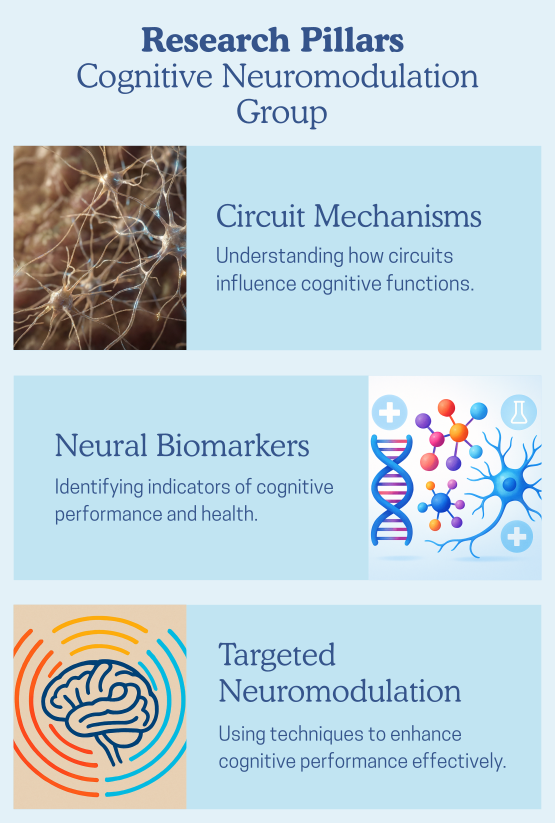
Our research is structured along three tightly connected axes that form a unified experimental and conceptual pipeline.
1. Circuit mechanisms of cognition
We study how cognitive functions are implemented at the level of neural circuits. A central goal is to understand how interactions between excitatory and inhibitory neurons, together with neuromodulatory inputs, give rise to stable yet flexible cognitive states. We focus on circuit dynamics across multiple temporal scales, examining how experience, internal state, and neuromodulatory tone shape information processing and behavioral performance.
2. Neural & cognitive biomarkers
A major emphasis of the group is the identification of measurable biomarkers that link circuit activity to cognitive function. We investigate behavioral, physiological, and network-level signatures that reflect cognitive states or dysfunction, with the aim of establishing markers that generalize across experimental conditions and species. These biomarkers provide a critical bridge between mechanistic circuit studies and human cognition, enabling translational relevance and cross-species comparison.
3. Targeted neuromodulation
Building on mechanistic insight and biomarker identification, we test causal strategies for modulating cognitive circuits. Neuromodulation is studied as a general control principle, with particular emphasis on cholinergic systems as a key exemplar. By manipulating neuromodulatory pathways and assessing their impact on circuit dynamics and behavior, we aim to define targeted approaches for restoring or enhancing cognitive function in disease-relevant contexts.


0002.jpg)